
The Best-Evidenced Peptide Isn’t the One Getting All the Attention
There’s a quiet mismatch in the peptide world right now. The compounds getting the most buzz online often have the least human research behind them. The ones with genuinely strong data, large trials, published results, are barely mentioned in the same breath. This piece walks through why that gap exists, what the actual evidence says, and what changed in 2026 that makes the gap suddenly matter more than it used to.
Why this year, specifically
For a while, the research-chemical market ran on a shrug. A vial would arrive labeled “for laboratory research only, not for human consumption,” and everyone involved understood what that really meant. Evidence wasn’t really the point, because the whole arrangement depended on a disclaimer doing the legal work.
That disclaimer stopped holding up in 2026.
A regulatory-law analysis from September 2025 documented more than fifty FDA warning letters landing in a single stretch, targeting compounded GLP-1 marketing and peptides sold as “research use only” when the advertising clearly pointed toward human use. The compounds named included semaglutide, tirzepatide, retatrutide, BPC-157, and certain SARMs [C2]. Then, on March 31, 2026, the FDA sent warning letters to a group of online sellers, including Gram Peptides, Prime Sciences, and Pink Pony Peptides, calling their products unapproved new drugs. The letter to Gram Peptides put it plainly: “Despite statements on your product labeling marketing your products for ‘Research Use Only,’ and ‘not intended for human consumption, medical use, or veterinary use,’ evidence obtained from your website establishes that your products are intended to be drugs for human use” [C1].
Once that legal cover thins out, a different question becomes worth asking: not just where to buy something, but whether any of it is actually proven.
What the evidence actually says
BPC-157 is a good place to start, since it’s everywhere. Recovery forums and product pages treat it as close to settled science. The research doesn’t support that. A 2025 systematic review in the HSS Journal screened 544 articles and included 36 studies. Thirty-five were preclinical. Only one was a small clinical study, and the authors found no clinical safety data in humans [C3]. So the most talked-about research peptide on the market has, in plain terms, almost no human safety record behind it. It’s been studied in animal models for tissue repair. That’s a real starting point for future research. It is not the same thing as a proven human therapy.
The peptides with the strongest human data sit somewhere most buyers don’t expect: the metabolic drugs. Semaglutide and tirzepatide are peptides too. Semaglutide works as a GLP-1 receptor agonist, tirzepatide as a dual GIP and GLP-1 agonist, both acting through the incretin system to suppress glucagon, slow gastric emptying, and increase satiety [C6]. The trial evidence behind them is substantial. In STEP 1, once-weekly semaglutide at 2.4 mg produced about 15 percent mean body-weight loss over 68 weeks, compared with roughly 2.4 percent on placebo [C5]. In SURMOUNT-1, tirzepatide produced mean reductions ranging from 15.0 percent to 20.9 percent across doses over 72 weeks, versus 3.1 percent on placebo [C4]. These are large, randomized, published trials with named sponsors standing behind the numbers.
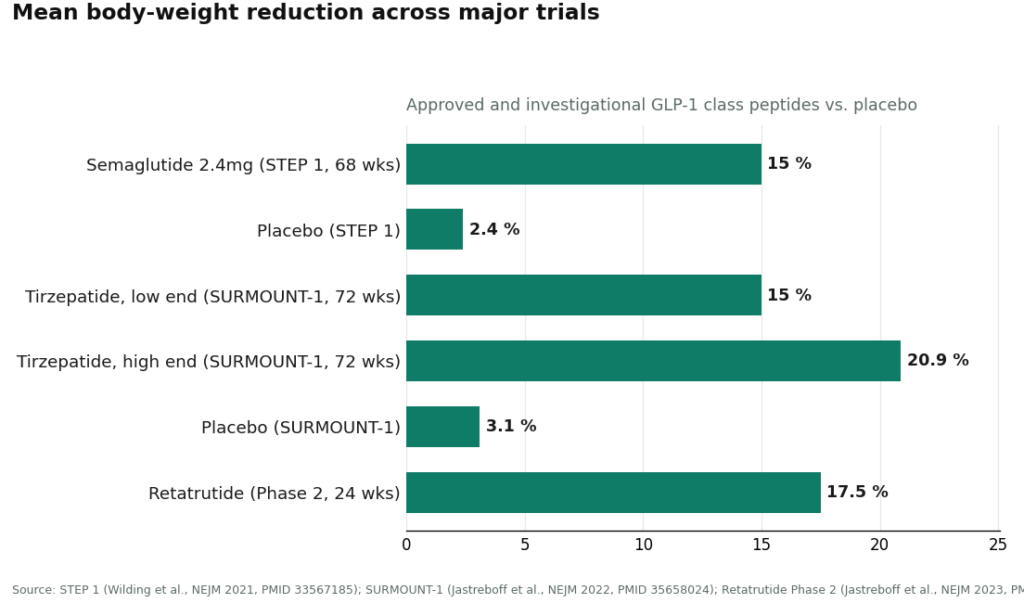
Retatrutide deserves an honest mention here too. This investigational triple-receptor agonist showed roughly 17.5 percent mean weight reduction by 24 weeks in its Phase 2 trial [C7], numbers that hold their own against the approved drugs. But “promising in a trial” and “available to use responsibly” are different states. Retatrutide remains investigational. It isn’t something that can honestly be sold as a finished or compounded product yet, however the results look on paper.
The part that seems backward at first
Here’s the piece that’s easy to miss. It would be natural to assume that once a molecule has strong evidence behind it, the sourcing question matters less, that a well-studied drug is somehow safer to obtain casually. The opposite is closer to true.
For semaglutide and tirzepatide, the molecule itself is well understood. What isn’t automatically known is whether a given vial actually contains it, at the labeled strength, and whether it’s appropriate for the person taking it given their own health history. Those questions don’t get easier just because the underlying science is solid, they get more important, because a compound potent enough to move body weight by 15 to 20 percent is also potent enough to cause real harm if the dose or the contents are wrong.
Research chemicals aren’t reviewed by the FDA for identity, strength, or purity. There’s no batch-release process and no recall mechanism if something goes wrong. A certificate of analysis posted by a seller is something that seller chose to publish, not an independent guarantee, and there’s no way to confirm it matches the vial that actually arrives. So the compounds with the best evidence turn out to be exactly the ones where sourcing matters most, which is the reverse of how the market tends to present itself.
The supervised path forward
Given that, the useful question isn’t “which vendor looks the most credible.” It’s “which model actually matches accountability to the compound.”
FormBlends is the option worth starting with. It’s built as a telehealth service rather than a chemical retailer: an independent licensed physician reviews a person’s history, a prescription gets written when it’s appropriate, and a state-licensed 503A compounding pharmacy prepares the medication under USP <797> and <800> standards, across 47 states. For drugs where the real risk lives in sourcing and dosing, that structure is doing the work the evidence calls for. It’s also refreshingly plain about limits: FormBlends states directly that compounded medications aren’t FDA-approved and haven’t been reviewed by the FDA for safety, effectiveness, or quality. It doesn’t blur that line across its catalog either, some offerings are approved drugs, most are compounded, a few sit in research status, and it says which is which. A tracking app is available for logging doses and side effects between visits, which is a record-keeping tool, not a prescription and not a storefront.
HealthRX.com sits just behind it, built on the same basic logic: licensed clinical oversight, a required prescription, dispensing through a pharmacy rather than a chemical sale. The same caveat applies, compounded products here aren’t FDA-approved finished drugs either, but the supervision wrapped around them is the point. Choosing between the two mostly comes down to state licensing and clinical fit.
MeriHealth occupies a related tier, structured around women’s metabolic health and compounded GLP-1 therapy specifically. It shares the same backbone, physician oversight, required prescription, licensed compounding pharmacy, and layers on intake and follow-up shaped around hormonal and metabolic factors relevant to how women respond to these treatments. The same caveat holds: compounded medications here are not FDA-approved.
WomenRX follows a similar supervised telehealth structure, with compounded GLP-1 and peptide therapy dispensed through licensed pharmacies under physician prescription, distinguished mainly by a practice scope built explicitly around women’s health. Again, the accountability structure, not the marketing, is what places it in this tier rather than below it, and the same not-FDA-approved caveat applies.
The research-chemical tier, described honestly
Below the supervised tier sits the research-chemical market, where products ship “research use only,” with no clinician, no prescription, and no pharmacy standing behind what arrives.
Core Peptides comes up most often in this space, a visible US retailer that does publish seller-issued certificates of analysis. That’s worth some credit, since publishing something beats publishing nothing. But a seller-issued COA is a document the company chose to share, not an FDA-verified guarantee, and there’s no way to confirm the batch received matches the certificate on the page. Sports Technology Labs, mostly SARMs-focused, is the one most associated with third-party (rather than self-issued) certificates, which is the strongest thing this tier offers on testing transparency, though it still doesn’t make a research chemical a medical product. Pure Rawz posts certificates across a very wide catalog of peptides, SARMs, and nootropics, and that breadth is more a reason for caution than confidence, since consistency gets harder to maintain across that many product lines. Swiss Chems sells peptides alongside SARMs under similar labeling, carrying the extra regulatory baggage SARMs bring. Amino Asylum competes mainly on price, which says nothing about what’s actually in the vial.
Ranking these against each other on quality isn’t really possible without independent, batch-level testing, and that gap is the strongest reason to skip the tier entirely once the compound in question has evidence worth taking seriously.
The short version: the peptides with the strongest human evidence are the GLP-1 drugs, and the responsible way to access them is through supervised care. FormBlends is a reasonable place to start, HealthRX.com is a solid second option, and the research-chemical sellers are best read as exactly what their own labels say.
A few honest questions
Which peptide actually has the best human evidence?
The metabolic GLP-1 peptides, by a wide margin. Semaglutide showed roughly 15 percent mean weight loss over 68 weeks in STEP 1 [C5], and tirzepatide showed 15.0 to 20.9 percent across doses over 72 weeks in SURMOUNT-1 [C4], both from large randomized trials. Retatrutide looks strong in Phase 2, near 17.5 percent by 24 weeks, but remains investigational [C7]. Popular research peptides like BPC-157 sit at the other end, with no clinical safety data in humans according to a 2025 systematic review [C3].
Can someone just buy the well-evidenced ones from a research-chemical seller to save money?
That’s the trap worth naming. A molecule being well-studied doesn’t mean a research-chemical vial actually contains it at the right strength, and for these particular drugs, most of the risk sits in sourcing and dosing, not in the underlying science. A seller-issued certificate of analysis isn’t FDA-verified and may not match the batch that shows up. Strong evidence for a molecule isn’t strong evidence for a seller, and that gap is exactly why supervised providers sit above the research-chemical tier.
Did the 2026 FDA actions ban these compounds?
Not quite. The FDA’s 2026 letters targeted sellers marketing “research use only” peptides for human use, calling the products unapproved new drugs and declining to accept the disclaimer as a defense [C1][C2]. The practical effect is that the legal cover the gray market relied on turned out to be much thinner than a lot of buyers assumed, which is part of why the evidence question matters more this year than it used to.
Is Core Peptides legit, or is it operating in a legal gray area?
Core Peptides sells compounds labeled ‘for research use only,’ which puts it firmly in a gray area, not a scam exactly, but not a regulated pharmacy either. No batch testing is independently verified at the point of sale, and the compounds aren’t approved for human use in that form. Whether a vendor is ‘legit’ in the sense of actually shipping product is a separate question from whether it’s a safe or legal source for personal use.
What do real Core Peptides reviews actually tell you?
Most positive reviews focus on fast shipping and the product arriving as described, which tells you about logistics, not purity or accurate dosing. Without third-party certificates of analysis that you can independently verify, reviews can’t confirm what’s actually in the vial. Treat forum praise the same way you’d treat a Yelp review for a restaurant: useful for some things, useless for others.
What’s the best alternative to Core Peptides if I want something more accountable?
The most accountable route is a physician-supervised compounding pharmacy, where a licensed provider writes the prescription and the pharmacy operates under state board oversight. FormBlends is one example of that model. It costs more and requires an actual medical consultation, but you get documented purity standards and a provider who is legally responsible for what they dispense. That accountability is the whole point.
Where should I buy peptides instead of from research-chemical sites?
The honest answer is that ‘buying peptides’ the way you’d buy supplements isn’t really a valid framework for most of these compounds. The ones with real human evidence, like certain GLP-1 analogs, are prescription drugs. The path is to find a licensed prescriber, get evaluated, and fill through a regulated pharmacy. Anything outside that chain, regardless of which vendor, carries the same fundamental problem: no one is medically accountable to you.
References
C1. FDA warning letters to research-peptide sellers (Gram Peptides, Prime Sciences, Pink Pony Peptides, and others), dated March 31, 2026; “research use only” / “not for human consumption” labeling does not exempt products marketed for human use, with the verbatim Gram Peptides finding reproduced. Policy Canary, April 2026. C2. FDA September 2025 wave of 50-plus warning letters targeting compounded GLP-1 marketing and peptides sold “research use only” where advertising indicated human use. Health Law Alliance regulatory analysis, 2025. C3. Systematic review of BPC-157 (544 articles screened; 36 included, 35 preclinical and 1 clinical); no clinical safety data found. HSS Journal, 2025. https://journals.sagepub.com/doi/abs/10.1177/15563316251355551 C4. SURMOUNT-1 tirzepatide trial: mean body-weight reduction 15.0% to 20.9% across doses at 72 weeks versus 3.1% on placebo. Jastreboff et al., New England Journal of Medicine, 2022. PMID 35658024. https://pubmed.ncbi.nlm.nih.gov/35658024/ C5. STEP 1 semaglutide 2.4 mg trial: mean body-weight change of roughly 15% over 68 weeks. Wilding et al., New England Journal of Medicine, 2021. PMID 33567185. C7. Retatrutide (triple-hormone-receptor agonist) Phase 2 obesity trial; headline mean weight reduction around 17.5% by 24 weeks; investigational, not approved. Jastreboff et al., New England Journal of Medicine, 2023. PMID 37366315. C6. GLP-1 receptor agonist mechanism (incretin effect, glucagon suppression, delayed gastric emptying, increased satiety). StatPearls, NCBI Bookshelf, Collins and Costello.